
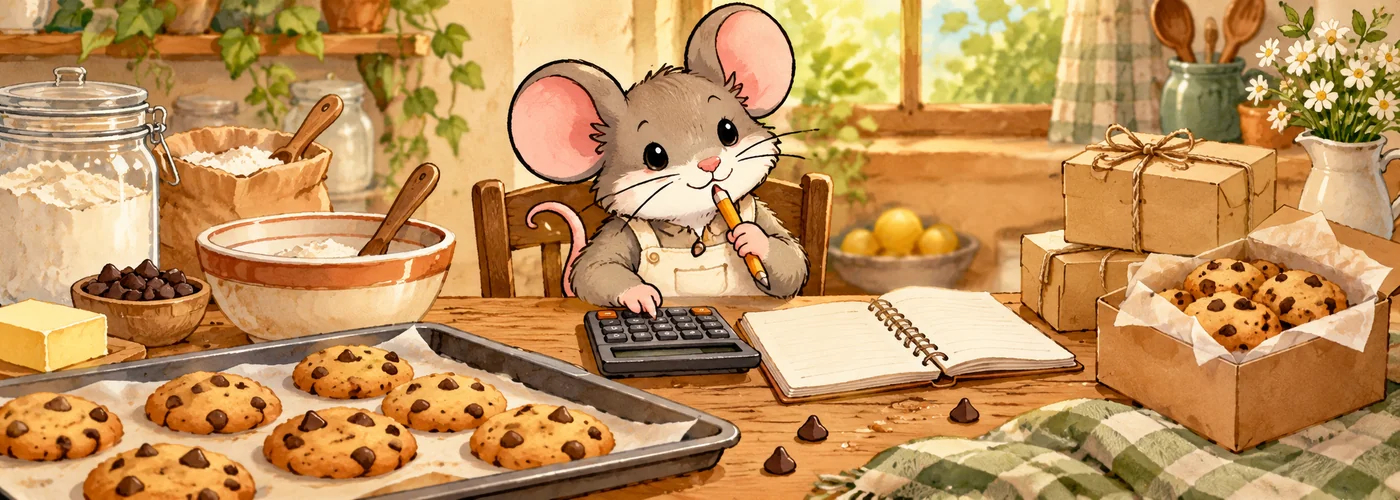
Price the batch you actually make
Choose a batch you make often and write down what went into it. Count the flour and butter, but also the box, tissue, labels, parchment, and payment fees. For decorated cookies, include icing colors, piping bags, and packaging that keeps the designs from rubbing together. Keep receipts for a few batches; estimates get better quickly when you can see what you spent.
Count your time from start to finish: shopping, mixing, baking, cooling, decorating, packing, answering messages, arranging pickup, and washing the last pan. Choose an hourly amount you would be glad to earn. You can change it later. Leaving your time out makes almost any recipe look like a bargain—especially to everyone but you.
Add a reasonable share of supplies and overhead, such as utilities and equipment wear. Keep a separate list of larger costs, including market fees and equipment purchases, so you can see what a batch costs and what the business as a whole must earn. Do not count the same expense in both places.
Here is a hypothetical batch of 24 cookies:
In this example, the 24-cookie batch costs $12 in ingredients, $6 in packaging and labels, $36 for two hours of labor at $18 an hour, and $6 for supplies and overhead: $60 total.
That is $2.50 per cookie before leaving room for profit. Selling all 24 for $60 would cover these estimates, assuming every estimate was right. It would leave nothing for a broken cookie, a quieter week, or the new mixer you will eventually need. Your ingredients, pace, and design work will be different; the useful number is the one from *your* kitchen.
Count the cost of showing up
A market day has costs before you sell a single cookie: the booth fee, perhaps a tent, and the time it takes to pack and set up. Monthly tools and insurance also need to be covered. The U.S. Small Business Administration’s break-even guide shows how fixed costs, price, and per-cookie costs fit together.
For example, suppose a market booth costs $40 and each cookie sold leaves $1 after its variable ingredients and packaging. You would need to sell 40 cookies just to cover the booth fee, before paying for your time or other costs. That is a simple example, not a suggested price. Use your own numbers, and keep the fixed fee separate from what each cookie costs to make.
Let a few sales teach you
After a few sales, look back at the numbers. Did the order take longer than you expected? Did you use two boxes because the first was too small? Which cookies sold out, and which came home? A notebook is enough. Put the date and recipe beside each note so you can see what changed when butter prices or portion sizes change.
When you post a price, show the size and quantity clearly. A photo of a box beside your hand or a familiar plate can help people understand what they are buying. Then give yourself permission to revisit the price. You are learning, your business is changing, and your time is worth counting every time.